T3 Hot & Happening Podcast 2026 – Part 2: AI, Automation, and the Future of Advice
T3 Hot & Happening Podcast 2026 – Part 2: AI, Automation, and the Future of Advice
The 2026 T3 Technology Tools for Today Conference brought the buzz, the breakthroughs, and the big ideas to New Orleans, where financial advisors and fintech leaders gathered to cut through the noise and get practical about what’s next in the financial services industry. From AI University to can’t-miss conversations on the latest wealthtech trends, the Hot & Happening Podcast series captured the energy and insights from this year’s conference.
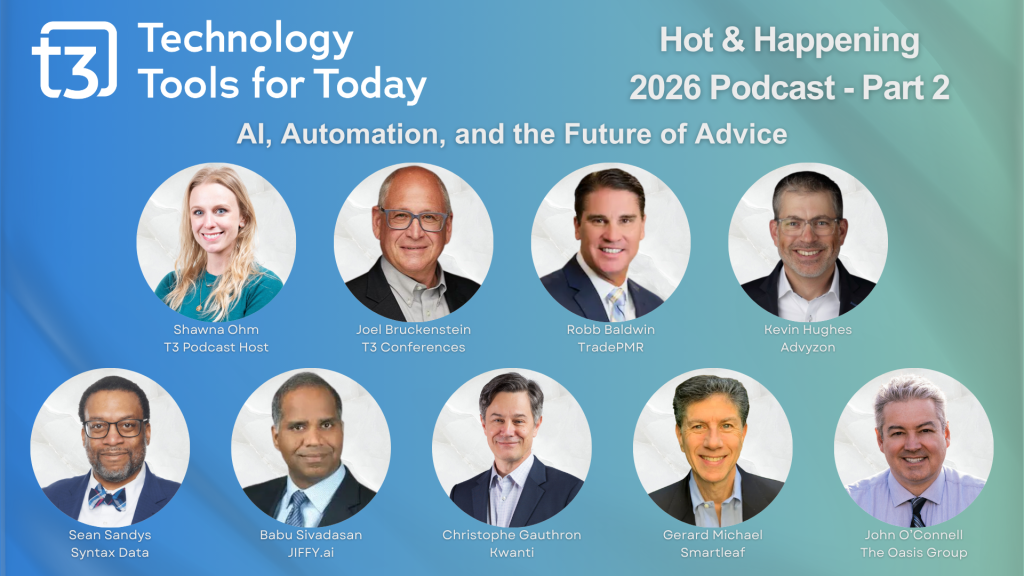
In part two of this three-part special series, Shawna Ohm of Content 151 sat down with a variety of fintech executives, consultants, and thought leaders – many of whom were speakers at #T32026 – to explore how firms are using AI more practically, why unified data and better workflows matter, and what advisors need to do now to scale, market effectively, and stay relevant as technology and client expectations evolve.
Guests include:
Joel Bruckenstein – T3 Technology Tools for Today: 0:47 – 6:34
Robb Baldwin – TradePMR: 6:35 – 12:52
Kevin Hughes – Advyzon: 12:53 – 19:02
Sean Sandys – Syntax Data: 19:03 – 25:14
Babu Sivadasan – JIFFY.ai: 25:15 – 30:56
Christophe Gauthron – Kwanti: 30:57 – 39:35
Gerard Michael – Smartleaf: 39:36 – 46:07
John O’Connell – The Oasis Group: 46:08 – 55:08
Check out Part 3 with even more great conversations!
Key Themes and Takeaways from Part 2
1) AI is now the headline, but practicality matters most
- AI University was described as a major success, drawing about 400 attendees and setting the tone for the conference with deeper, more actionable sessions than the usual “AI hype” presentations.
- Guests repeatedly stressed that advisors want plain-language guidance, not theory, and that the best sessions focused on what AI can actually do in a practice today.
2) Advisors need to scale to serve the next generation
- Multiple guests emphasized a looming mismatch: fewer advisors in the future, but many more clients needing advice, which means firms must scale through technology and better systems.
- The next-gen client experience must be fast and digital, with tools that help people choose advisors, open accounts, and engage on their terms.
3) Marketing is becoming a survival skill for advisors
- One of the clearest takeaways was that advisors can no longer rely only on relationships or referrals; they need a real local marketing strategy because national firms are already competing for the same prospects.
- Marketing has become one of the four core priorities for future-proofing a firm, right alongside scaling, choosing modern partners, and adopting better technology.
4) Unified data is the foundation for useful AI
- Several guests argued that AI is only as good as the data behind it, which is why unified systems and single data models matter so much.
- A common message was that fragmented tech stacks weaken AI, while integrated platforms can give AI a fuller client picture and make its outputs more useful and reliable.
5) Automation should handle the boring, repetitive work
- A recurring theme was that anything routine, manual, or low-value should be automated so advisors can spend more time on planning, coaching, and client relationships.
- Examples included rebalancing, onboarding, workflow execution, note-taking, and account-opening tasks that can be streamlined or fully automated.
6) AI governance and workflow design are now essential
- Guests pushed the idea that firms should not just adopt AI; they should set policies, define boundaries, and understand exactly where AI is being used and how data is handled.
- A practical starting point was offered: assess AI readiness, create an acceptable-use policy, then pick one workflow and build from there.